


The Challenge
KarmaCheck is the leader in background checks, identity verification, and trust infrastructure for the AI era. Founded by Eric Ly, a co-founder of LinkedIn, KarmaCheck is redefining how organizations across industries verify people quickly, safely, and fairly. From staffing and marketplaces to fintech and healthcare, KarmaCheck is helping customers make smarter, faster, and more compliant trust decisions at scale.
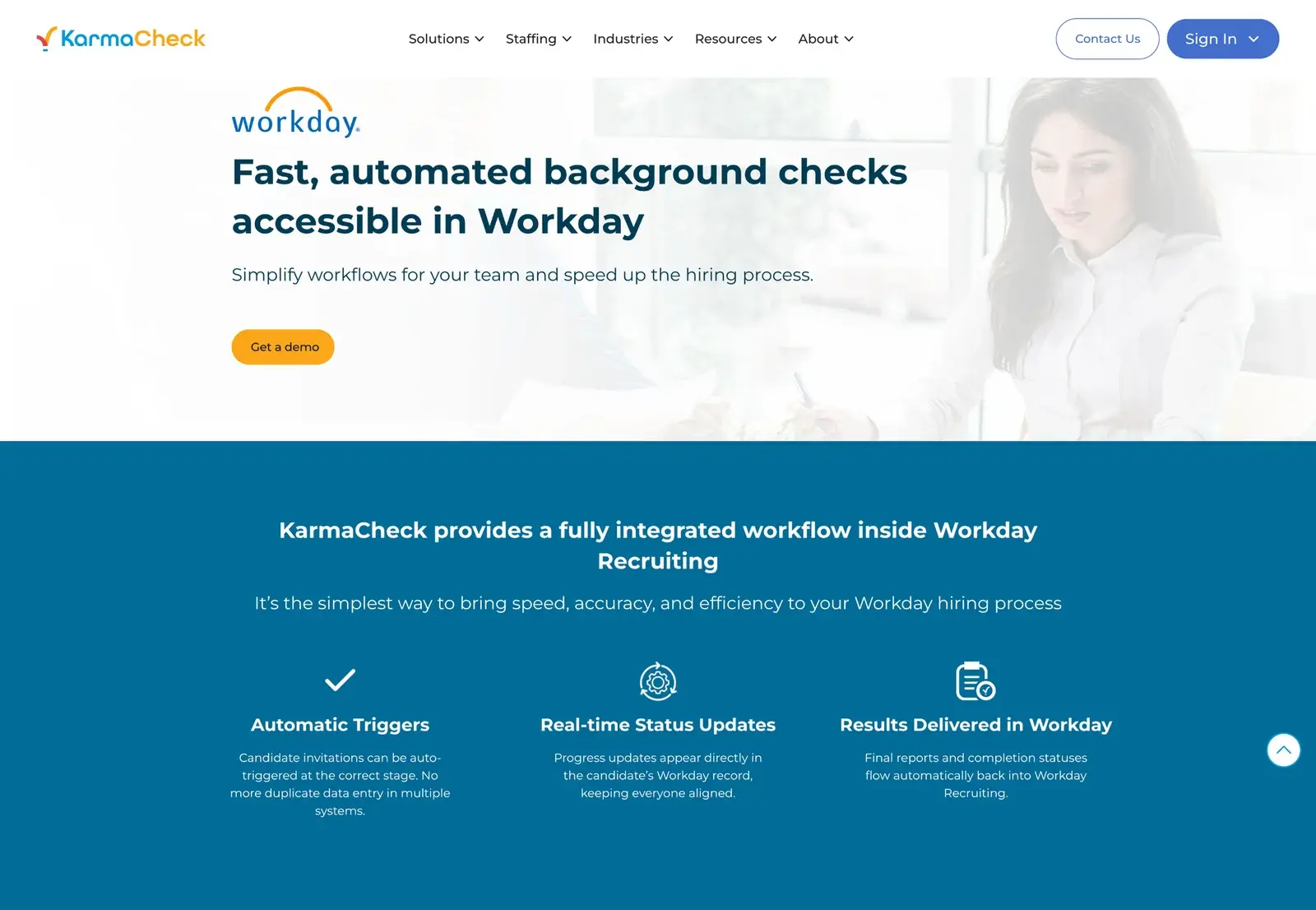
For background screening to feel native to the recruiter, it has to live inside the ATS they already work in. When a recruiter moves a candidate to the screening stage, the order needs to fire automatically, real-time statuses need to be written back, and the completed report should be attached for audit trails. Without this, teams face compliance risks from stale statuses, missing audit trails, and manual transcription.
It's really critical to have real-time updates, making sure accurate information is getting back into the system of record, and that your team doesn't have to keep context-switching and system-switching.
– Erin McCarthy, Senior Director of Product
Why building in-house wasn’t an option
As KarmaCheck expanded into the enterprise segment, a Workday integration quickly became a prerequisite for being considered in deals. Their engineering team had all the capabilities to build it internally - their Bullhorn integration is widely considered an industry benchmark. But the team prioritized AI-driven compliance workflows—where their engineering investment would deliver the greatest long-term impact.
KarmaCheck first considered different iPaaS and unified API vendors, but couldn’t find one that had built out sufficient depth and was willing to develop an integration specifically for the then-newly released background check API. This led them to Kombo—the only partner willing to co-develop against the newly released API and deliver the required depth.
The Solution
Design partner for Workday's Background Check API
KarmaCheck became the launch design partner for Kombo's integration with Workday's new Background Check API. The choice came down to Kombo co-developing against the new Workday Background Check API, bringing expertise in background screening, and providing a Workday sandbox from the start.
Real-time, service-level status visibility
KarmaCheck's background check packages are a bundle of sub-screenings that complete on different timelines: criminal records, drug screens, license verifications, identity checks, and occupational health items. But most existing Workday background check integrations only expose a single overall order status, leaving recruiters to context-switch into the vendor's UI for screening details.
Kombo enables KarmaCheck to write back every sub-screening into Workday in real time with human-readable comments. Final reports are returned as attachments to the job application, so they’re available for audit.
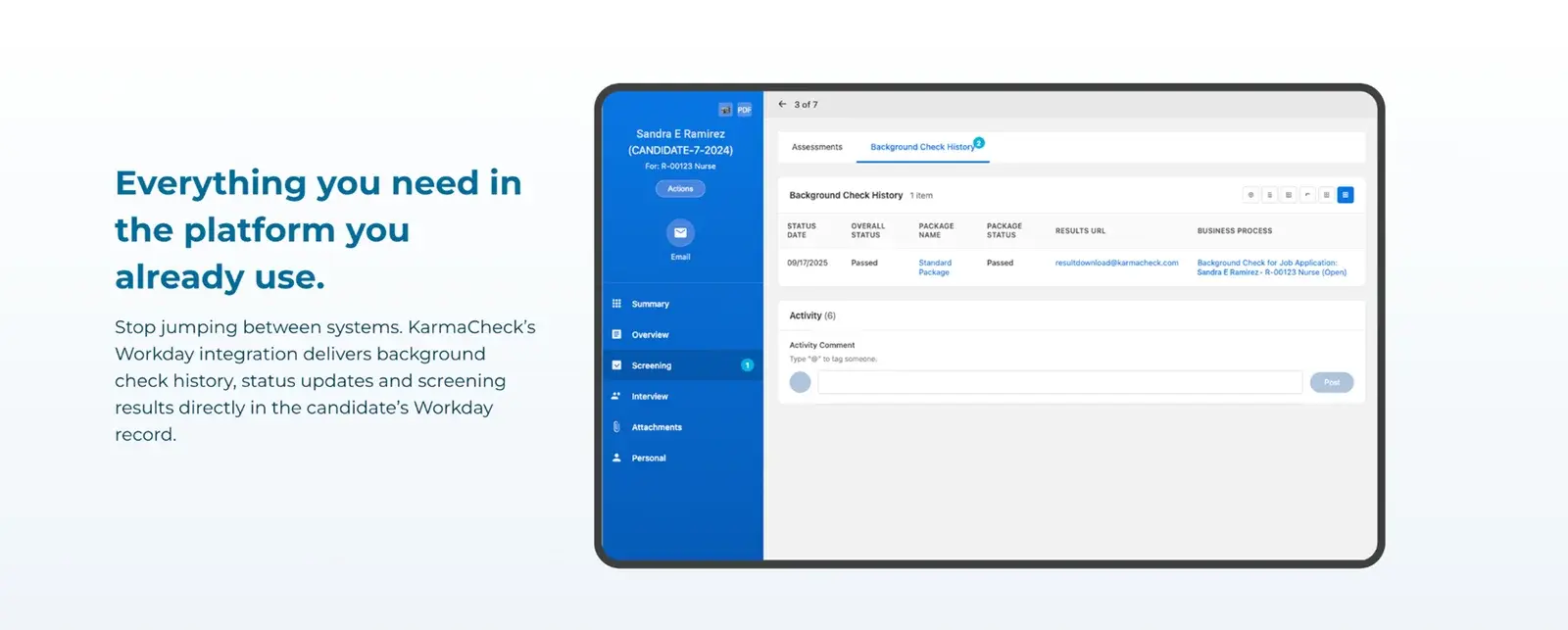
Customers love that we post real-time updates on every service directly into their ATS, for the lifecycle of the case.
– Erin McCarthy, Senior Director of Product
Embedded engineering partnership
Beyond the integration itself, KarmaCheck has bi-weekly check-ins and a shared Slack channel with the product engineer who built the integrations. And the partnership also extends into architectural decisions. Early in the design phase, when KarmaCheck initially scoped the integration around per-application API calls, Kombo's team pushed back and recommended a bulk-fetch approach with delta syncs. This avoids the ATS-specific rate limits that can otherwise throttle real-time data flows at scale.
Kombo over-delivered. A new partnership naturally comes with some uncertainty, but Kombo quickly proved themselves. They delivered ahead of schedule, and consistently followed through at every step.
– Erin McCarthy, Senior Director of Product
The Outcome
Freed up months of engineering capacity
Choosing to partner with Kombo freed up KarmaCheck's engineering team to focus on core product work. With an average of four to five weeks of development per integration, building coverage for the 54 integrations provided by Kombo would have required three engineers to work exclusively on this for 17 to 21 months.
Workday integration as a competitive differentiator
The depth of the Workday integration has emerged as a differentiator against larger incumbents, and led to KarmaCheck winning competitive deals.
I just had a prospect tell me, this is better than what's out there in the market. I had a couple of demos in the last few weeks where they're comparing us against other vendors, and the Workday integration is now a real reason we're winning.
– Erin McCarthy, Senior Director of Product
Integration infrastructure for agents
Since starting to work with Kombo, KarmaCheck has shipped industry-leading capabilities, including credentialing workflows and its first AI agent for compliance workflows. The agent extracts and validates credential data from candidate documents, and proactively reaches out to candidates when certifications are about to expire.
Kombo’s infrastructure enables the agents to interact with the systems their customers work in. Extracted data and processed documents can be posted back into Workday, with additional ATS integrations and compliance workflows on the joint roadmap.
Our roadmap is centered on AI-driven automation, focused on closing the most costly gaps in compliance workflows. With Kombo as part of our connectivity layer, customers can run agents directly within their system of record—ensuring data flows seamlessly to where it’s needed.
– Erin McCarthy, Senior Director of Product
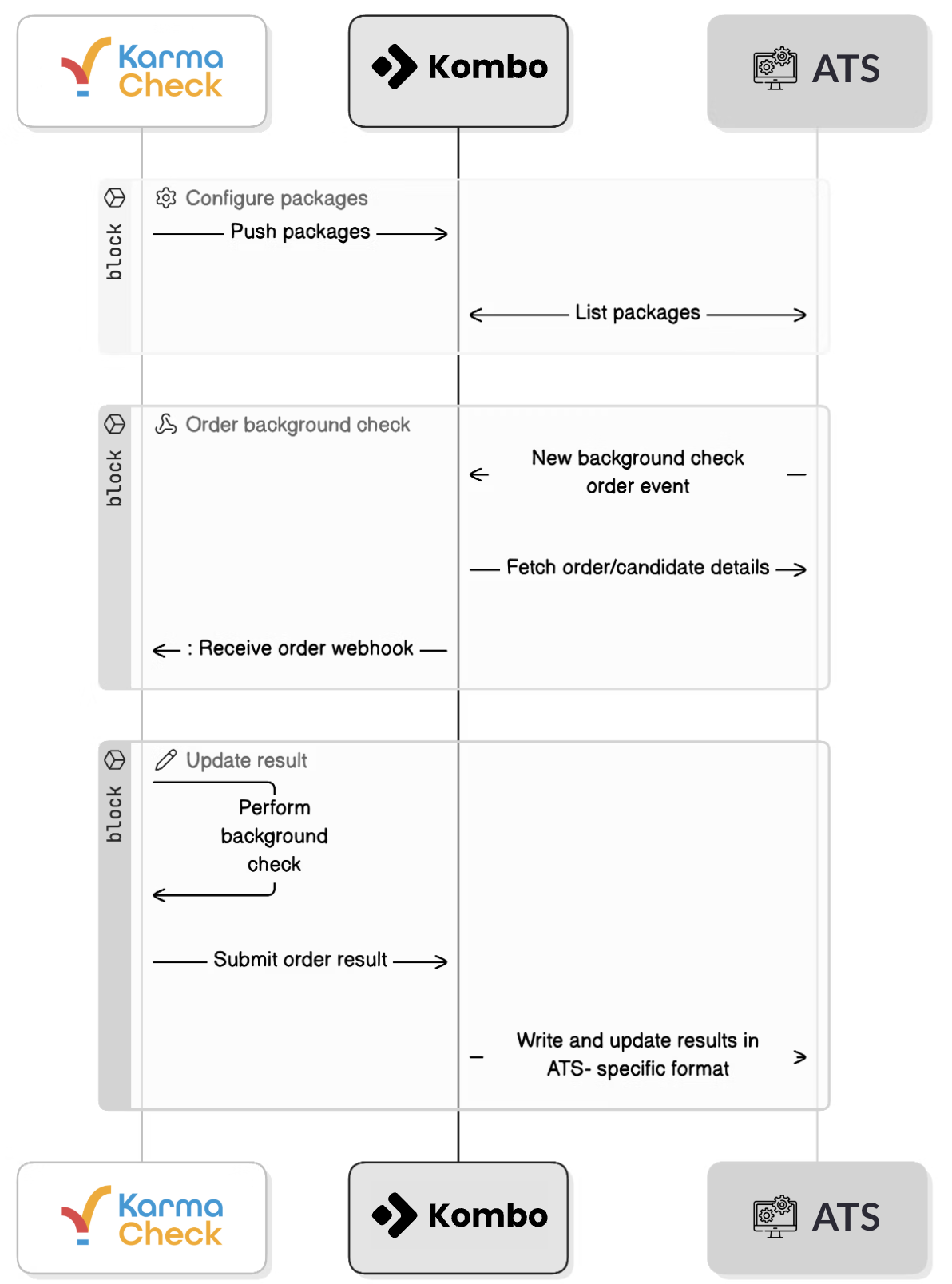
How KarmaCheck uses Kombo:
All your integrations with one API
Integrate Kombo once – offer hundreds
of integrations off the
shelf to your customers.