
Guide to Assessment Integrations in 2026

Assessment integrations are becoming essential for enterprise readiness, faster sales cycles, and customer stickiness.
With the ongoing shift towards skills-based hiring, recruiting pipelines filled with AI-generated resumes, and rising identity fraud, talent teams are increasingly using assessments to cut through the noise. As more companies enter the market, assessment integrations have become essential for winning and retaining customers, especially in the enterprise segment.
This guide covers what assessment integrations are, which systems matter for which segment, common use cases, and the most effective ways to build and maintain them, including how Kombo’s unified Assessment API lets you integrate once and connect to 18 ATS assessment modules.
What are assessment integrations?
An assessment integration connects an assessment provider to the assessment module of an applicant tracking system (ATS), the system companies use to manage their recruiting pipeline. It allows to share candidate data, trigger assessments, and write back structured scores programmatically, thereby freeing up recruiters from manual copy-paste and switching systems.
Assessment integrations fall into two categories:
- Customer-facing integrations: These connect your assessment product with a third-party ATS used by your customers. For example, a skills testing provider integrates with a customer’s Workday instance so recruiters can trigger assessments and view results without leaving their ATS.
- Internal integrations: These connect your own assessment tools with internal HR systems to automate workflows like compliance screening or onboarding assessments for new hires.
For B2B SaaS companies, customer-facing assessment integrations deliver the most strategic value. They are often a prerequisite for being considered in enterprise deals, and they improve retention among connected customers.
Assessment API vs. ATS API: what is the difference?
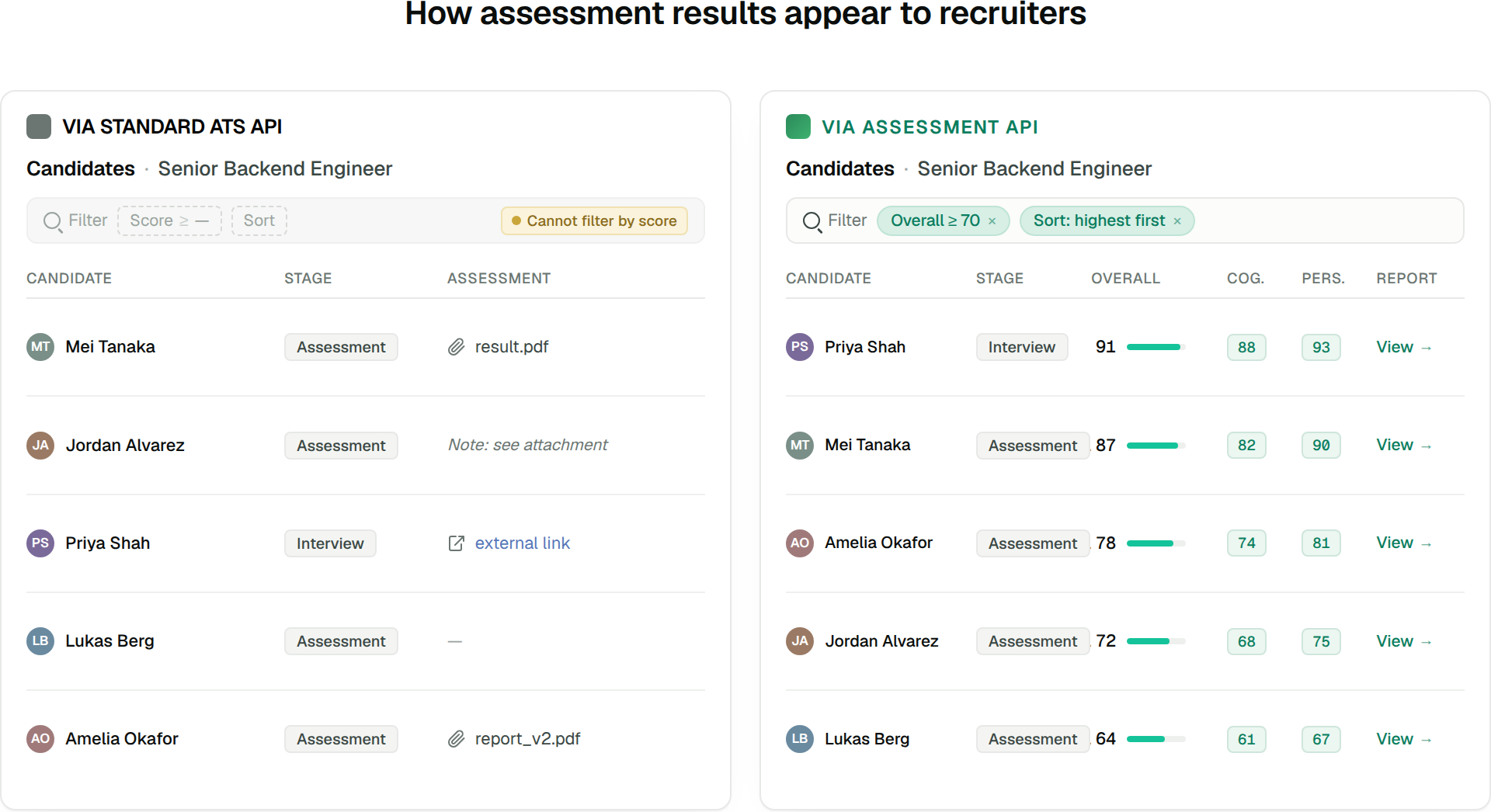
A standard ATS API gives you access to candidate data, applications, jobs, and stage changes. It is built for reading and writing general recruiting data. An Assessment API, by contrast, is a dedicated interface that some ATS platforms expose specifically for assessment providers.
It lets you publish test packages to the ATS, receive real-time webhooks when a recruiter orders an assessment for a candidate, and write back structured results (such as scores, sub-scores, and report attachments) that recruiters can filter and rank directly in their workflow.
As not every ATS offers a dedicated assessment API, assessment providers frequently have to resort to the standard ATS API. The workaround typically uses stage-change listeners to trigger assessments and write back the results as notes, links, or attachments. Although this works, recruiters lose the ability to filter candidates by their scores within the ATS.
Most common ATS platforms for assessment integrations in 2026
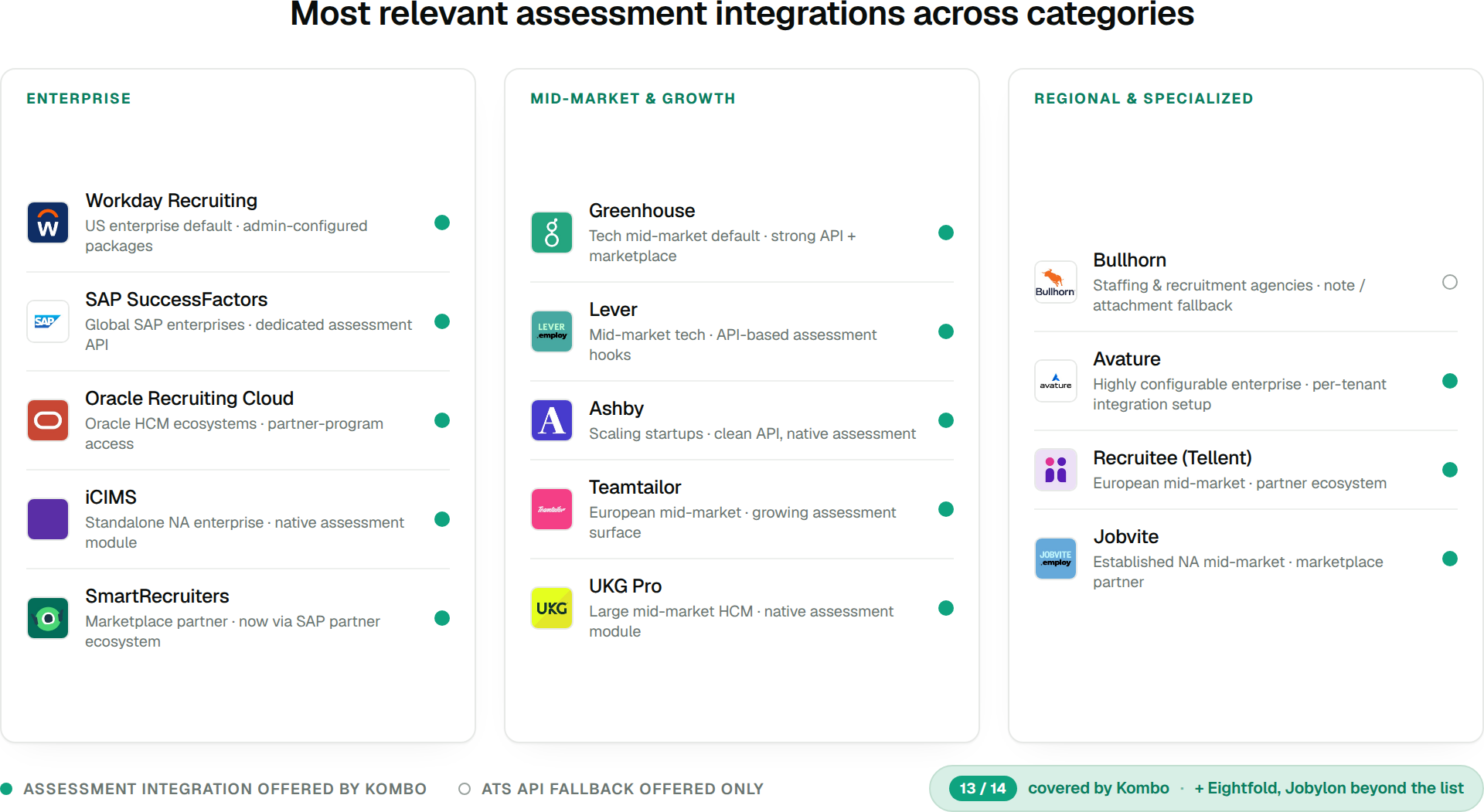
The ATS landscape is incredibly fragmented. Even after working in it for years, we stumble across a new ATS that we’ve never heard of at least once a month. To make it easier to prioritize your roadmap, we’ve listed the systems that typically matter most to assessment providers below.
Enterprise
- Workday Recruiting: Deeply embedded in Workday’s HCM suite, with a dedicated assessment API. Dominant in large US enterprises. Assessment packages must be configured within Workday by the customer’s admin.
- SAP SuccessFactors: A leading enterprise ATS in Europe and for global organizations running SAP. Supports a dedicated assessment API for triggering evaluations and writing back structured results.
- Oracle Recruiting Cloud: Part of Oracle’s HCM Cloud, and common in Oracle-heavy enterprise environments. Supports assessment integrations through its partner ecosystem.
- iCIMS: One of the largest standalone enterprise ATS platforms in North America, with a dedicated assessment module.
- SmartRecruiters: Enterprise-grade ATS with a dedicated assessment API and marketplace partner program. After being acquired by SAP, all new technology partnerships and integrations will now be managed through the SAP Partner Ecosystem (which might take longer than it did before).
Mid-market and growth
- Greenhouse: The dominant ATS among tech-forward mid-market and growth companies. It comes with a strong API ecosystem and marketplace.
- Lever: Popular ATS for mid-market tech companies. Supports assessment integrations through its API.
- Ashby: Fast-growing ATS among startups and a leading choice for scaling tech companies. Provides a very clean API with assessment support.
- Teamtailor: European-focused ATS gaining traction globally, with assessment integration capabilities.
- UKG Pro: Broad HCM suite including ATS and assessment modules. Common in large mid-market organizations.
Regional and specialized
- Bullhorn: Dominant in the staffing and recruitment agency space. Supports assessment and background check integrations.
- Avature: Enterprise ATS with heavy configurability, used by large global organizations with complex hiring workflows. They don’t provide a standard API in the way Greenhouse or Ashby do. Each Avature integration requires a sync with your prospect/customer and their account management team, and the interface you get depends on what Avature configures for the specific end-customer.
- Recruitee (Tellent): Popular in the European mid-market, with a growing partner ecosystem.
- Jobvite: Established mid-market ATS in North America with assessment integration support.
How to build assessment integrations
The right approach depends on how many integrations you need, your engineering bandwidth, and how critical ATS connectivity is to your product.
Custom API integrations
Most companies start by building directly against each ATS provider’s API. This gives you full control over the data model and user experience, but each integration requires significant development effort. Scoping the API, handling authentication, normalizing data, managing assessment-specific workflows, and QA can take weeks to months per integration.
Best for: Companies that only need one or two ATS integrations and have dedicated engineering resources.
Drawback: It does not scale well. Each new integration adds weeks of work, and maintenance costs compound over time. Assessment APIs also vary widely across ATS platforms, and will require you to find workarounds through notes, attachments, and stage-change listeners.
Unified APIs
A unified API consolidates multiple ATS assessment APIs behind a single standardized interface. You integrate once and get access to all supported ATS platforms through the same endpoints, data models, and authentication flow.
Kombo’s unified Assessment API, for example, lets you publish assessment packages, receive order webhooks, and write back structured results (scores, sub-results, report attachments) across 18 ATS systems, including Workday, SAP SuccessFactors, Oracle Recruiting Cloud, SmartRecruiters, Greenhouse, Lever, Ashby, and more, through a single integration.
Best for: Companies that need to support multiple ATS platforms and want to ship integrations in days instead of months.
Drawback: You depend on the unified API provider’s coverage and depth. Choose a provider that specializes in your domain. Generic middleware and horizontal iPaaS tools typically cannot handle the edge cases of assessment-specific data flows.
iPaaS solutions
Integration platform as a service (iPaaS) tools such as Workato and Tray provide low-code connectors for various applications. They can handle basic data sync between an assessment tool and an ATS.
Best for: Internal integrations with simple workflows (e.g., syncing assessment completion status to an internal dashboard).
Drawback: iPaaS tools are horizontal. They support thousands of app categories but lack depth in any one domain. Using them for customer-facing assessment integrations that require normalized data models, structured result write-back, and domain-specific error handling typically falls short.
ATS API (non-assessment) as fallback
For ATS platforms that do not offer a dedicated assessment API, some companies use the standard ATS API as a fallback. This approach listens for application stage changes to trigger assessments and writes results back as notes, attachments, or result links.
Best for: Extending coverage to ATS platforms where no dedicated assessment API exists.
Drawback: Recruiters cannot filter or rank candidates by assessment scores within the ATS. The integration is technically more complex for your engineering team, and the user experience is less polished than a native assessment integration.
Challenges of assessment integrations
Maintenance overhead compounds fast
Every new assessment type or product feature you launch needs to work across every ATS you support. TestGorilla, for example, had built 16 ATS integrations in-house with 700+ connected customers. Before being able to launch a new assessment format, they had to update all of them.
ATS-specific assessment workflows
Every ATS handles assessments differently. Some have dedicated assessment APIs with structured package management and result schemas (Workday, SmartRecruiters). Others require workarounds through application notes, attachments, or custom fields. Some platforms require customers to manually configure assessment packages on their end (Workday).
Data normalization
Every ATS stores and displays scores, sub-scores, pass/fail status, completion timestamps, report links, and detailed attribute data differently. Normalizing result data into a consistent format shouldn’t come at the expense of the richness of your assessment output. If the only thing a recruiter sees is an overall score, they have almost nothing to base a shortlisting decision on.
Write operations
Writing assessment results back to an ATS is significantly harder than reading candidate data. Each ATS has different required fields, validation rules, and display formats for assessment results. A result write-back that works on Greenhouse might fail on Oracle if you do not handle its specific field requirements. Supporting structured sub-results, custom attributes, and file attachments adds additional complexity.
Ongoing maintenance
ATS providers update their APIs, deprecate endpoints, and change assessment module behaviors. Each change requires investigation, code updates, and regression testing across your integration. Without dedicated tooling and monitoring, these changes can silently break integrations and erode customer trust.
Benefits of assessment integrations
For B2B SaaS companies
- Expand your addressable market. Supporting more ATS platforms means you can serve more customers. Integration coverage is a deciding factor in enterprise procurement, particularly for Workday, SAP, and Oracle customers.
- Shorten sales cycles. When a prospect asks “Do you integrate with our ATS?” the answer should be yes. Pre-built integrations remove a common blocker from deal negotiations.
- Reduce churn. Automated data sync between your product and the customer’s ATS creates a sticky integration. Customers who trigger assessments directly from their ATS are less likely to switch providers.
- Free up engineering. Every hour spent building and maintaining ATS integrations is an hour not spent on your core assessment product. Offloading integration complexity lets your team focus on differentiation.
For customers and end users
- Streamlined recruiter experience: Recruiters trigger assessments and view results without leaving their ATS. No context switching, no manual data entry.
- Faster time-to-hire: Automated assessment triggers and real-time result delivery reduce delays in the hiring pipeline.
- Better hiring decisions: Structured assessment data (scores, sub-results, report links) displayed directly in the ATS enables data-driven candidate evaluation and comparison.
- Audit-ready records: Assessment results stored in the ATS create a centralized, compliant record of every hiring decision.
Simplify assessment integrations with Kombo
If you need to integrate with multiple ATS assessment modules, Kombo’s unified Assessment API makes it possible with a single integration.
Kombo is the infrastructure layer for all people data. Our unified API is purpose-built for HR tech and covers 193 API-based HRIS and ATS integrations, including payroll through the HRIS API, plus 18 assessment and background-check integrations and 10 LMS integrations. Companies like HireVue, TestGorilla, Experian, Saville Assessment, and Zinc already use Kombo to connect with their customers’ ATS systems for assessment workflows.
Here is what Kombo’s Assessment API offers:
- One API, 18 ATS assessment modules. Publish packages, receive order webhooks, and write back structured results across Workday, SAP SuccessFactors, Oracle Recruiting Cloud, SmartRecruiters, Greenhouse, Lever, Ashby, iCIMS, UKG Pro, Bullhorn, Teamtailor, and more, through a single standardized interface.
- Full read and write support. Set assessment packages per customer, receive real-time webhooks when assessments are ordered, and write back scores, sub-results, report attachments, and completion timestamps. The same endpoints and data model work across every connected ATS.
- Structured result write-back. Deliver rich result data (overall scores, sub-scores, text attributes, and PDF reports) in formats optimized for each ATS. Kombo handles the mapping so recruiters see clean, actionable data in their native workflow.
- ATS API fallback for extended coverage. For ATS platforms without a dedicated assessment module, Kombo’s standard ATS API provides fallback coverage through notes, attachments, result links, and stage-change listeners, extending your reach to 108 ATS systems.
- Enterprise-grade monitoring. See sync status, authentication issues, and errors across every customer connection from one dashboard. Set up webhooks to catch issues before they become support tickets.
- Domain expertise included. Our support engineers deeply understand ATS and assessment workflows. You get dedicated Slack channels, sandbox access for most systems, and hands-on onboarding support.
Find out more:
All your integrations with one API
Integrate Kombo once – offer hundreds
of integrations off the
shelf to your customers.