
The Best Unified API Platforms for ATS and HRIS Integrations in 2026

There are multiple Unified APIs offering you to connect to HRIS and ATS systems, but not all of them are built equal for HR tech.
The integration challenge in HR Tech
If you’re building in HR tech, you know the pain: your customers use dozens of different HR tools, and they all need to talk to each other. The typical enterprise often uses more than 80 different HR solutions. But here’s where it gets interesting: according to recent industry data, 81% of companies experience higher customer retention and 68% see improved close rates as a direct result of adding integrations.
However, developing these integrations is no simple task. It typically takes companies 4–5 weeks to develop a single integration, and several months for complex enterprise systems like Workday and SAP SuccessFactors. And this doesn’t include the waiting period for approval and sandbox access.
Unified APIs have emerged as a solution to this integration challenge. Instead of building separate integrations to each system, you build once to the unified API and gain access to dozens of systems. The unified API handles the complexity of normalizing data models, authentication flows, and rate limits, and often provides sandbox access for testing. But not all unified API solutions are built equal — especially when it comes to the specific demands of HR tech.
Why HR tech needs specialized unified API platforms
Generic integration platforms might work fine for syncing marketing tools or CRM data, but HR data comes with its own challenges:
- You’re dealing with sensitive employee and applicant information, putting higher emphasis on compliance and security.
- The data models are complex and come with many edge cases — especially for enterprise systems.
- Many use cases require real-time, bi-directional capabilities at scale.
- It’s a very fragmented market, where each system comes with unique quirks (that are frequently not publicly documented).
How to evaluate unified APIs for ATS and HRIS integrations
When evaluating unified APIs for HRIS and ATS integrations, product and engineering leaders typically consider three factors:
- Deep workflow capabilities: Can they solve your specific use case, and have they done it for similar companies before? You don’t want to discover during a customer onboarding that critical workflows aren’t supported, or that you’re their first customer to use and debug an integration. Look for relevant customer references and explicit coverage for each integration in their documentation.
- Integration coverage: How many ATS and HRIS systems are currently supported, and how likely is the company to add coverage when you request it? This determines whether you can scale with them and confidently say “yes” to new integration requests from customers. Check their changelog and track record with existing customers.
- Reactive support: When something breaks, how responsive and experienced is their support team? Especially when integrating new systems, you need knowledgeable engineers who understand HR workflows. Test the quality of their support during your evaluation by asking specific HR workflow questions and system-specific edge cases.
Top HR tech unified API platforms
Here are the primary unified API solutions for HRIS and ATS integrations to consider.
| Company | API-based HRIS integrations | ATS systems listed | Differentiator | Customer examples (for ATS + HRIS) |
|---|---|---|---|---|
| Kombo | 85 | 108 | Exclusive HR focus with deepest workflow coverage | Indeed, Experian, Juicebox, Gem, TestGorilla, Paychex, Greenhouse, Thatch, HireVue |
| Merge | 80 | 63 | Multi-category platform with strong brand presence | Ramp, Navan, BrightHire, Foxit, Drata, Lattice, BambooHR |
| Finch | 38 | 0 | Payroll and benefits specialization | Brex, Coinbase, Morningstar, Secureframe, Mercury, Betterment, Vanta |
| Knit | 66 | 40 | Developer-first accessibility | Multiplier, Payoneer, PeopleStrong, Scrut Automation, OutSolve, Insurity, Payworks |
| Bindbee | 50 | 12 | Entry-level simplicity | BenefitsMe, BudgieHealth, Giftpack, Grazzy, Phin, Papershift |
HRIS counts include only integrations backed by a public or partner API, verified September 16, 2026. ATS counts are the connectors in each provider’s public catalog on October 13, 2026, excluding deprecated connectors, sandbox connectors and duplicate listings of the same system.
Kombo
Kombo has emerged as a leading choice for HR tech companies that need reliable, deep integrations with a strong support culture.
Strengths:
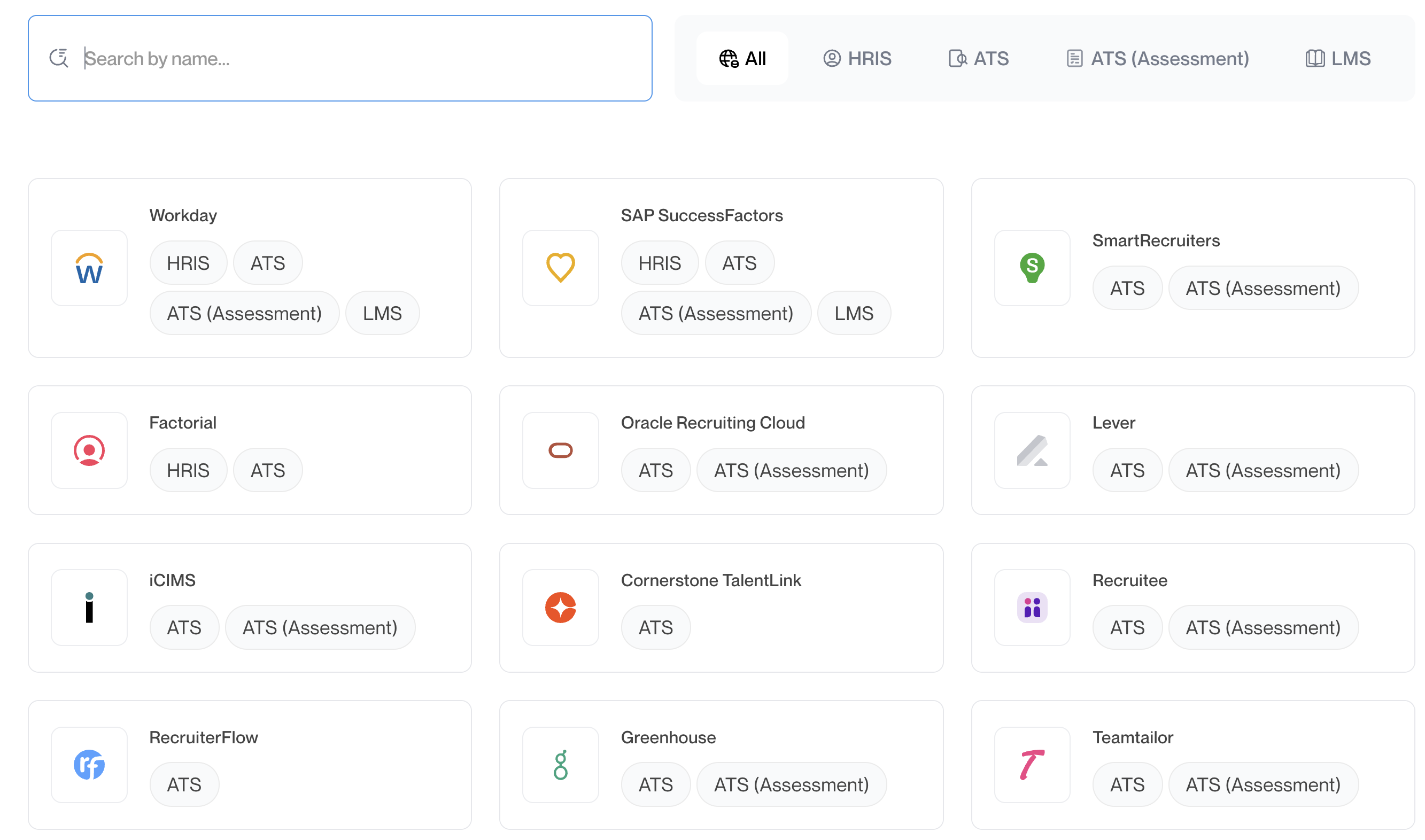
- Integration coverage: The widest coverage in the US and European market, with 193 HRIS and ATS integrations that is constantly being expanded. It’s also the only solution covering the adjacent LMS and Assessment (ATS) verticals with sufficient depth.
- Unique focus on people data: Kombo focuses on ATS and HRIS integrations. This allowed them to build the deepest coverage in the market in recent years, and to offer sandbox access for enterprise systems such as Workday and SAP SuccessFactors.
- Engineering-led support: A technical team with HR domain expertise acquired over four years in the space provides hands-on support and implementation assistance. This is best exemplified by Kombo earning the highest “quality of support” rating on G2 among unified APIs, at 9.9/10 (source).
Considerations:
- Integration categories: Companies requiring integrations beyond HR (such as accounting and CRM) will need to combine Kombo with other specialized solutions, like Rutter.
- Geographic focus: Kombo is focused on the US and Europe, but is also starting to serve customers in APAC.
Customer examples: Indeed, Experian, Juicebox, Gem, TestGorilla, Paychex, Greenhouse, HireVue, Thatch
Merge
Merge has established itself as a comprehensive integration platform serving multiple categories including HR, with significant market presence and funding.
Strengths:
- Broad platform coverage: Extensive integrations across HR, CRM, accounting, and other categories like file storage.
- Enterprise infrastructure: Merge has developed advanced observability tools and debugging capabilities.
- Brand recognition: Merge has been around the longest of all unified APIs in HR tech. They have a strong market presence and an established customer base.
Considerations:
- Focus trade-offs: Serving multiple categories means balancing priorities across verticals and customer groups. Their current focus appears to be on AI companies and financial firms.
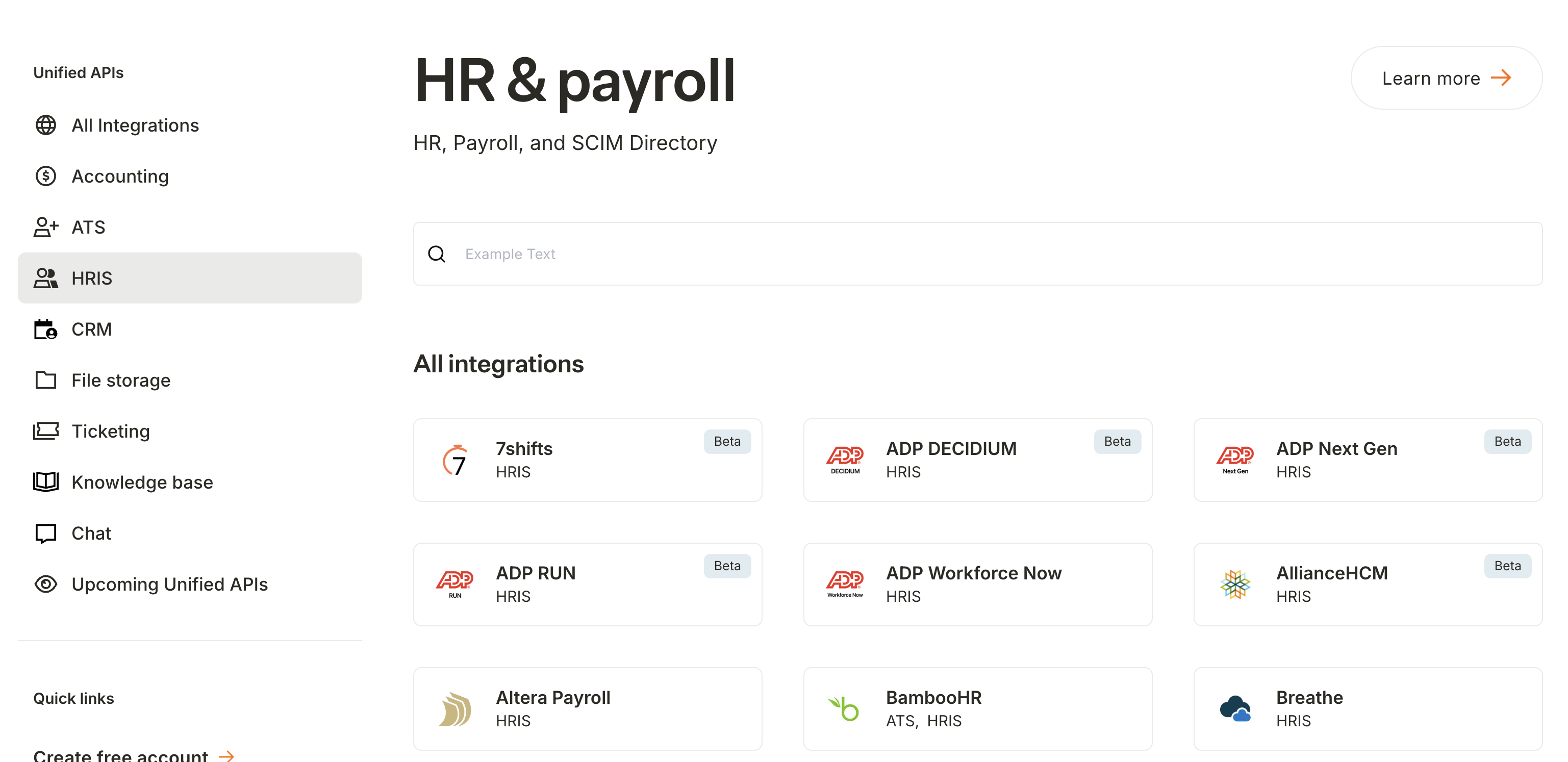
- Beta status: As of October 2026, 59 of the 140 HRIS and ATS integrations on Merge’s integrations page are listed as “Beta,” which Merge uses for integrations without widespread customer adoption.
- Integration depth: While they cover many systems, the actual workflow depth can vary across integrations. Evaluate specific workflows for your use cases by checking their docs and coverage grid.
Customer examples: Ramp, Navan, BrightHire, Foxit, Drata, Lattice, BambooHR
Finch
Finch has carved out a clear niche by focusing exclusively on payroll and benefits data, becoming a leading solution in this specific segment.
Strengths:
- Unmatched payroll coverage: Finch offers the broadest coverage in the market for payroll systems (250+ systems).
- Domain expertise: Deep understanding of payroll complexity, tax implications, and benefits administration across the US.
- Strong security: Their infrastructure is designed specifically for handling sensitive payroll data.
Considerations:
- No ATS support: Finch doesn’t provide coverage for ATS systems.
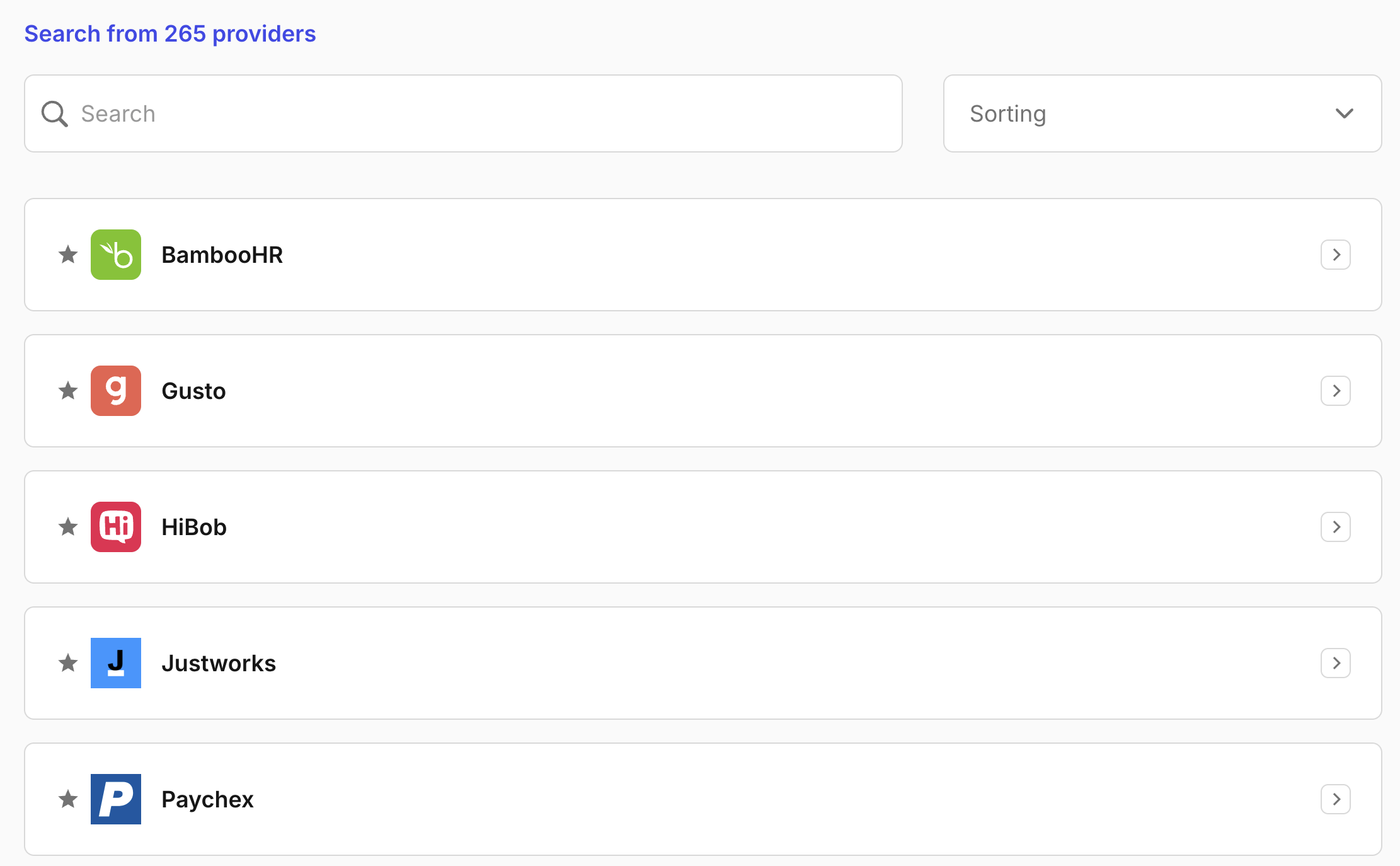
- HRIS depth: Finch focuses on payroll-related use cases. Finch lists 38 API-based HRIS integrations, which sync every 24 hours by default and weekly on some systems.
Customer examples: Brex, Coinbase, Morningstar, Secureframe, Mercury, Betterment, Vanta
Knit
Knit has recently entered the market with a developer-friendly design and accessible pricing.
Strengths:
- Competitive pricing: Knit’s Start Up plan starts at $499 per month, making it a very affordable option for teams eager to get started.
- Well-documented APIs: Knit has built out great documentation that shows its commitment to the developer experience.
- Quick setup: The setup experience has proven very straightforward, with G2 awarding them the leader badge for “ease of integration” in Spring 2025.
Considerations:
- Support quality: With a smaller team based in India that covers multiple categories, it might be challenging for them to provide a high level of support for integrations.
- Early-stage: As a newer player in the space, a fair share of their HRIS and ATS integrations likely haven’t been extensively tested yet.
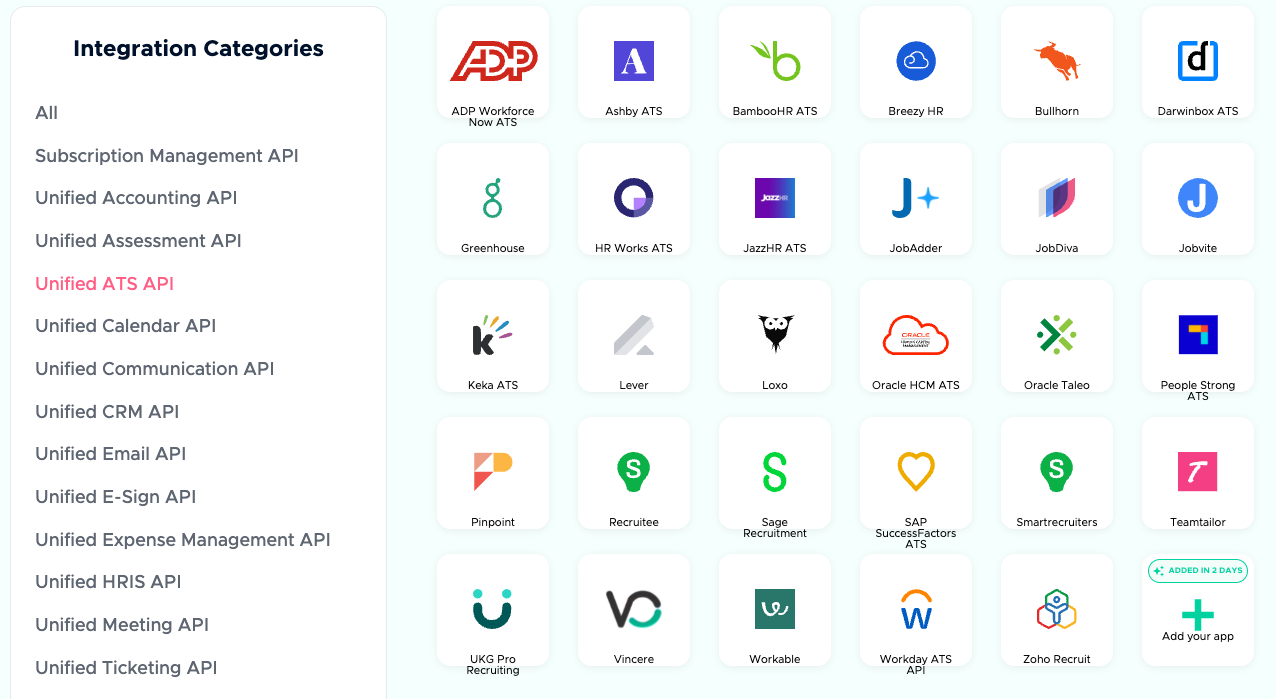
- Coverage and depth: Knit currently supports a limited number of systems, and their write capabilities and advanced workflows are still being developed.
Customer examples: Multiplier, Payoneer, PeopleStrong, Scrut Automation, OutSolve, Insurity
Bindbee
Bindbee provides a straightforward solution for teams looking to quickly implement basic HR integrations at an accessible price point.
Strengths:
- Affordable entry point: Bindbee offers one of the most accessible pricing tiers in the market, making it viable for bootstrapped startups and small teams.
- Simple implementation: The platform focuses on essential data synchronization with a simple setup process that gets teams running quickly.
Considerations:
- Support responsiveness: Based in Bangalore, India, and in the market for only a year, the team may find it challenging to provide high-quality support across US time zones.
- Workflow depth: The platform is optimized for read-heavy use cases and essential data sync, with less focus on complex bi-directional workflows.
- Coverage: Bindbee currently covers some of the most common HR systems, which may not span the full range of platforms your customers use.
Customer examples: BenefitsMe, BudgieHealth, Giftpack, Grazzy, Phin, Papershift
Making your decision
Picking the right solution for your HRIS and ATS needs can be challenging. Most teams focus on the following criteria during their testing:
- Validate your use cases: Test the exact use cases you want to build with live integrations. This often surfaces gaps that companies might not communicate openly — such as unsupported workflows for key systems.
- Fit for scale: Assess how each company’s focus aligns with your growth plans and how likely they are to prioritize your future system requests. Switching providers after 1–2 years typically leads to high costs and disrupts product development.
- Pricing and costs: Weigh total costs against coverage, support quality, and implementation guidance. When building the business case, teams typically compare expected costs against three key benefits: unlocking new customer segments for upselling and acquisition, reducing ongoing maintenance burden, and freeing engineering resources for core product development.
- Support quality: If the support engineers aren’t responsive and knowledgeable during your POC, it likely won’t improve once you’ve signed.
All your integrations with one API
Integrate Kombo once – offer hundreds
of integrations off the
shelf to your customers.